
Card Games After Solitaire: The Math Inside a Retro Video Poker Hand
Anyone who used a PC in the nineties remembers the card games that came with it. Solitaire, FreeCell and Hearts sat in the Windows menu next to Minesweeper, waiting for a slow afternoon. They were small, quiet and impossible to leave alone, because every deal was a fresh puzzle.
Video poker belongs in the same family. It has the same short rounds and the same little voice saying “just one more”. The difference is that this puzzle can be solved exactly.
Most poker is about other people. You read faces, count bets and try to work out whether the player across from you is bluffing. Take all of that away and something interesting is left behind: five cards, one choice, and a number you can calculate exactly.
That’s video poker. You’re dealt five cards, you decide which ones to keep, the rest are replaced once, and your final hand pays according to a table. Nobody else is involved. It’s less like a card game and more like a puzzle that deals itself a new position every few seconds.
And because it’s a puzzle, it has answers. To show what they look like, we took five hands and counted every single draw that could follow. The payouts come from free video poker that runs in a browser tab, in a window styled after Windows 98, and uses only virtual coins, so there’s no real money anywhere in this story. Just math, and a few answers that feel wrong until you see the count.
The only rule you need: average payout
After the deal, 47 cards are left that you haven’t seen. If you throw away one card, there are 47 possible results. Throw away two and there are 1,081. Throw away three and there are 16,215. That sounds like a lot, but it’s a finite list. You can go through all of it, look up what each result pays, and take the average.
That average is how much a hold is worth, measured in bets. A hold worth 2.0 returns twice your bet over a very long run. A hold worth 0.5 returns half. The best play is simply the hold with the biggest number.
Here’s the pay table used for every figure below, as it stands at the time of writing:
| Hand | Pays | Hand | Pays |
|---|---|---|---|
| High Card | x0.1 | Flush | x15 |
| Pair | x0.2 | Full House | x25 |
| Two Pair | x4 | Four of a Kind | x45 |
| Three of a Kind | x5 | Straight Flush | x90 |
| Straight | x7 | Royal Flush | x5000 |
Two things stand out. A pair barely pays anything, and any pair pays the same, so a pair of twos is as good as a pair of aces. Keep that in mind. It changes more decisions than you’d expect.
Hand 1: the humble pair
You’re dealt: Q♦ Q♣ J♥ 8♣ 2♥
The obvious play is to keep the queens and draw three. But lots of players also hang on to the jack, because high cards feel valuable. Let’s count.
- Keep the two queens: worth 1.73 bets.
- Keep the queens and the jack: worth 1.47 bets.
The kicker costs you. Holding it gives up one of your three chances to find another queen, and gets almost nothing in return, because high cards have no special value on this table.
Here’s how those 16,215 draws from a plain pair break down:
| You finish with | Draws | Chance |
|---|---|---|
| Still a pair | 11,559 | 71.3% |
| Two Pair | 2,592 | 16.0% |
| Three of a Kind | 1,854 | 11.4% |
| Full House | 165 | 1.0% |
| Four of a Kind | 45 | 0.3% |
So a pair improves a little more than one time in four. It’s not much on its own, but every one of those improvements is a real win, and that’s enough to make the pair the solid, boring, correct choice most of the time.
Most of the time.
Hand 2: the pair you should throw away
You’re dealt: 7♦ 9♦ 7♣ J♦ 2♦
Now you have a pair of sevens and four diamonds. You can’t keep both plans. Hold the pair, or break it and chase the flush?
Nine diamonds are left among the 47 unseen cards, so the flush comes in 9 times out of 47, or 19.1%. More than half the time you end up with nothing but a high card. It feels reckless.
- Keep the pair of sevens: worth 1.73 bets.
- Keep the four diamonds: worth 2.98 bets.
It isn’t close. The flush pays x15, and one success in five at that price easily beats a steady stream of small improvements. This is the first lesson of the draw: what matters isn’t how often you win, it’s how often multiplied by how much.
Hand 3: when a free draw is really free
You’re dealt: K♠ K♥ 7♦ 7♠ 3♥
Two Pair already pays x4. Drawing one card can’t hurt it, because the four cards you keep are still two pair whatever arrives.
- Stand pat: worth exactly 4.00 bets.
- Keep both pairs, draw one: worth 5.79 bets.
- Keep only the kings, draw three: worth 1.75 bets.
Four cards turn the hand into a Full House: two kings and two sevens. That’s 8.5%, or about one time in twelve, and it costs nothing to try. When your hand is already locked in, there’s no reason to refuse the draw.
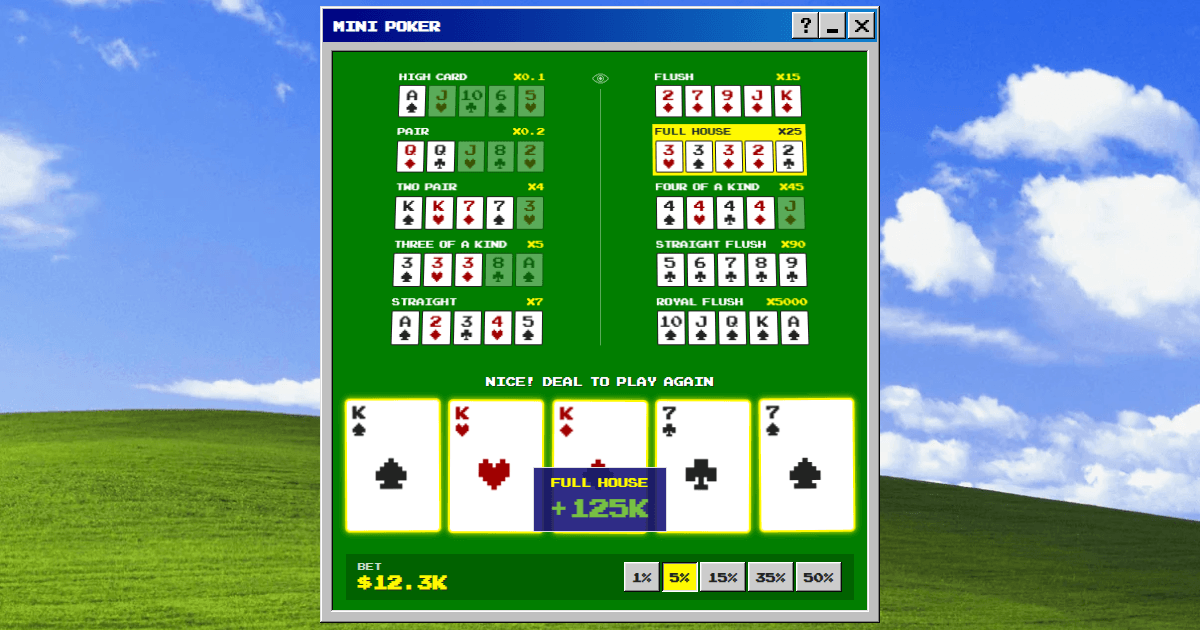
The one-in-twelve draw that pays: kings and sevens become a Full House.
Hand 4: the tempting ace
You’re dealt: 3♣ 3♥ 3♦ 8♣ A♠
Three of a Kind pays x5 before you do anything. As with two pair, keeping the threes means you can’t go backwards. The question is whether to hold the ace as well and hope for a pair with it.
- Keep the threes, draw two: worth 7.92 bets.
- Keep the threes and the ace, draw one: worth 7.13 bets.
Two fresh cards beat one again. With two draws you get a Full House 6.1% of the time and the fourth three 4.3% of the time. Same story as the jack in Hand 1: a spare high card looks like help, but what it really does is take a draw away from you.
Hand 5: the one that hurts
You’re dealt: 10♥ J♥ Q♥ K♥ 3♥
It’s a flush. It’s already made, and it pays x15 without any further luck. And the right play is to break it.
Throw away the three and look at the 47 cards that could replace it:
| You finish with | Cards that do it | Pays |
|---|---|---|
| Royal Flush | 1 (the ace of hearts) | x5000 |
| Straight Flush | 1 (the nine of hearts) | x90 |
| Flush again | 6 | x15 |
| Straight | 6 | x7 |
| Pair | 12 | x0.2 |
| High card | 21 | x0.1 |
Seven times out of ten you’ll turn a good hand into a pair or worse. And yet:
- Keep the flush: worth exactly 15.00 bets.
- Break it for the royal: worth 111.20 bets.
Almost all of that comes from one card. Five thousand divided by 47 is about 106, so the ace of hearts alone is worth seven flushes. It’s the clearest example there is of why “how often” and “how much” have to be read together. The same logic means that even three cards to a royal (10♠ J♠ Q♠ with two blanks) are worth 5.93 bets, which is far more than a pair.
The answers in one table
| Situation | Best hold | Worth in our example |
|---|---|---|
| Four to a Royal Flush, even with a made flush | The four royal cards | 111.20 |
| Three of a Kind | The three, draw two | 7.92 |
| Three to a Royal Flush, nothing else made | The three royal cards | 5.93 |
| Two Pair | Both pairs, draw one | 5.79 |
| Four to a flush | The four suited cards | 2.98 |
| One pair | The pair, draw three | 1.73 |
| Four to a straight, open at both ends | The four in a row | 1.30 |
Treat it as a rough guide rather than a full strategy chart. The exact value of a hold shifts a little with the cards you throw away, and all of these numbers belong to this pay table. Change the payouts and some of the lines swap places, which is exactly why it’s worth understanding where the numbers come from instead of memorizing them.
Why it’s a good way to practice
The nice thing about five card draw against a pay table is the pace. There’s no waiting for other players, so you can work through a lot of decisions in a short sitting. The poker hand rankings sink in without studying, and so does a feel for what 19% or 2% actually looks like when you live through it a few dozen times.
The version used here is a mini game inside Spacebar Clicker, a retro idle game with a Windows 98 desktop, where you earn virtual coins by pressing the space bar and then spend them on phones, PCs and servers. The bets are a percentage of that virtual balance. You can’t buy coins and you can’t cash them out, so a bad run costs you nothing but a bit of clicking.
So next time you’re looking at a small pair and four hearts, you’ll know. Drop the pair, draw one card, and be wrong four times out of five. Over enough hands, you’ll still come out ahead.
